INCOTERMS 2020 Explained: What Every Export-Import Professional Must Know
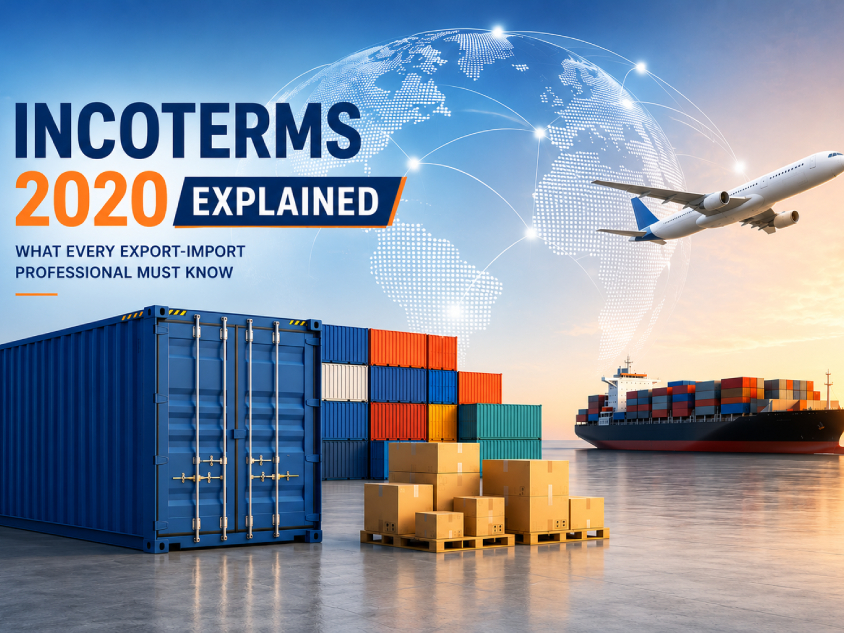
In international trade, understanding INCOTERMS 2020 is essential for Exporters, Importers, Freight forwarders and Logistics professionals. INCOTERMS 2020 Explained simply means understanding the responsibilities, costs and risks shared between buyers and sellers during global trade transactions.
Published by the International Chamber of Commerce (ICC), INCOTERMS help avoid confusion and disputes by clearly defining who pays for transportation, insurance, customs clearance and delivery.
Some of the INCOTERMS 2020 are mentioned below.
1.EXW (Ex Works)
Under EXW, the seller makes the goods available at their premises, and the buyer bears almost all transportation costs and risks from that point onward.
Example:
A manufacturer in Mumbai sells goods under EXW terms. The buyer arranges pickup, export clearance, shipping, and delivery to the final destination.
2. FOB (Free On Board)
FOB is one of the most commonly used INCOTERMS in sea freight. The seller is responsible until the goods are loaded onto the vessel at the port of export.
Example:
An exporter in Chennai ships goods FOB Chennai Port. Once the cargo is loaded on the vessel, the risk transfers to the buyer.
3. CIF (Cost, Insurance and Freight)
Under CIF, the seller pays for transportation and insurance up to the destination port. However, the risk transfers to the buyer once the goods are loaded onto the ship.
Example:
An Indian exporter sells goods CIF Dubai. The exporter pays freight and insurance, while the importer handles customs clearance and inland transportation in Dubai.
4. DDP (Delivered Duty Paid)
DDP places the maximum responsibility on the seller. The seller manages transportation, customs clearance, duties, taxes and delivery to the buyer's specified location.
Example:
An exporter in India sells products DDP Toronto, Canada. The exporter bears all costs and risks until the goods reach the buyer's doorstep.
Why Learning INCOTERMS 2020
Matters Understanding INCOTERMS 2020 helps professionals:
- Avoid costly misunderstandings in international trade.
- Clearly define buyer and seller responsibilities.
- Improve logistics and supply chain planning.
- Prepare for careers in export-import management, freight forwarding and customs operations.
Ettintl’s courses help learners transition from warehouse-level operations to strategic global distribution roles.
👉 Visit Ettintl: https://www.ettintl.com
Final Thoughts: Want to Master INCOTERMS 2020 and Build a Career in Global Trade?
At ETTI Export Import Management Institute, we cover INCOTERMS 2020, export-import documentation, customs procedures, freight forwarding and much more — with practical training, industry-experienced faculty and 100% Placement Assistance.
🎓 Online & Offline Batches Available | Mumbai | Zoom Live Lectures
📞 Call Mr. S. Kumar: +91 9594564459 / 8850955833
🖱️ Enquire Now → | View Courses →
FAQs
- What are INCOTERMS 2020?
INCOTERMS 2020 (International Commercial Terms) are a set of 11 standardized trade terms published by the International Chamber of Commerce (ICC) that define the responsibilities, costs, and risks shared between buyers and sellers in international trade transactions. They help avoid confusion and disputes in global trade by clearly stating who is responsible for transportation, insurance, customs clearance, and delivery of goods. - What is the difference between FOB and CIF in INCOTERMS 2020?
Under FOB (Free On Board), the seller's responsibility ends once the goods are loaded onto the vessel at the port of export — after that, the buyer bears all costs and risks including freight and insurance. Under CIF (Cost, Insurance and Freight), the seller pays for freight and insurance up to the destination port, but the risk still transfers to the buyer once the goods are loaded on the ship. The key difference is that under CIF, the seller arranges and pays for shipping and insurance, whereas under FOB, the buyer does. - Which INCOTERM is most favorable for the buyer?
EXW (Ex Works) gives the buyer the most control but also places the maximum responsibility on them — the buyer handles pickup, export clearance, shipping, insurance, and final delivery. However, from a cost and risk perspective, DDP (Delivered Duty Paid) is the most favorable for the buyer because the seller bears all costs and risks including customs duties, taxes, and last-mile delivery right to the buyer's door. - What does DDP mean in INCOTERMS 2020?
DDP (Delivered Duty Paid) is the INCOTERM that places the maximum obligation on the seller. Under DDP, the seller is responsible for all costs and risks involved in delivering the goods to the buyer's named destination — including export clearance, international freight, insurance, import customs clearance, duties, taxes, and inland delivery in the buyer's country. For example, an Indian exporter shipping DDP Toronto, Canada, handles every step until the goods reach the buyer's premises in Canada. - How many INCOTERMS are there in 2020?
There are 11 INCOTERMS in the 2020 edition, published by the International Chamber of Commerce (ICC). They are divided into two categories — 7 terms applicable to any mode of transport (EXW, FCA, CPT, CIP, DAP, DPU, DDP) and 4 terms applicable only to sea and inland waterway transport (FAS, FOB, CFR, CIF). The 2020 revision introduced key updates including new rules for insurance under CIP and the use of FCA for letters of credit shipments. - Why is it important to learn INCOTERMS 2020 for an export-import career?
Understanding INCOTERMS 2020 is a fundamental skill for anyone working in export-import management, freight forwarding, customs brokerage, or international logistics. INCOTERMS directly impact pricing, contract terms, insurance coverage, and risk liability. Professionals who understand these terms can avoid costly misunderstandings, negotiate better trade contracts, plan efficient supply chains, and build successful careers in global trade. Most export-import course curricula in India, including at ETTI, cover INCOTERMS as a core subject. - Are INCOTERMS 2020 legally binding?
INCOTERMS 2020 are not automatically legally binding — they become legally enforceable only when they are explicitly referenced in a trade contract or sales agreement. When a buyer and seller agree to use a specific INCOTERM (e.g., "FOB Mumbai Port, INCOTERMS 2020") in their contract, that term defines the legal obligations of both parties regarding risk, cost, and responsibility. It is always recommended to clearly mention the applicable INCOTERM version (2020) and the specific named place in all trade contracts. - What is the best INCOTERM for a new Indian exporter to use?
For new Indian exporters, FOB (Free On Board) is generally the most recommended and commonly used INCOTERM. Under FOB, the exporter is responsible for delivering goods to the port of export and loading them onto the vessel — tasks that are within the exporter's control in India. The buyer then takes over from that point. This limits the exporter's risk exposure while still being straightforward to manage. As exporters gain experience, they may use CIF or DDP to offer more value-added services to international buyers.


